Many customers think label quality depends mainly on print clarity and color. But for self-adhesive label professionals, one truth is clear: up to 80% of label problems occur not because of poor printing, but because of incorrect material selection.
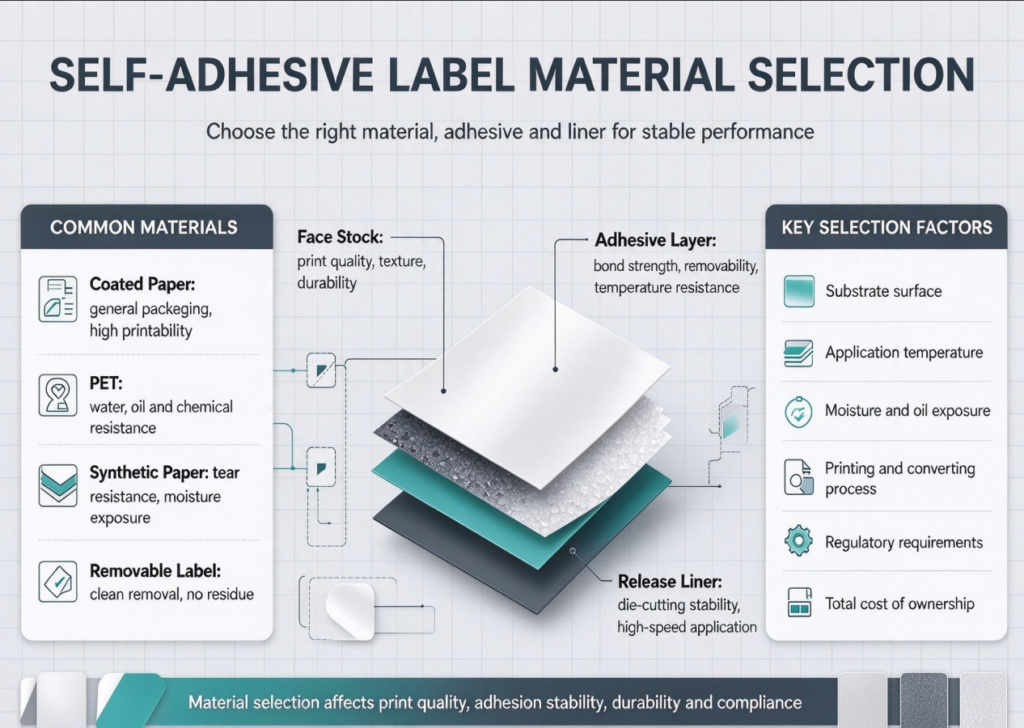
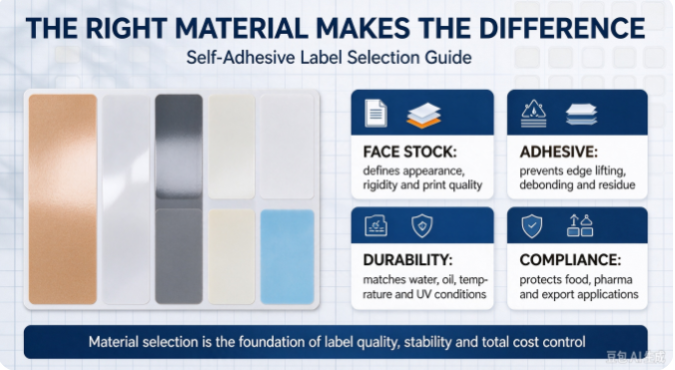
With the same artwork, press, and operator, a label can perform very differently when the face material, adhesive, or liner is changed. Material defines the label’s visual quality, adhesion stability, durability, regulatory compliance, and total cost. In short, printing technology sets the upper limit, but material selection sets the bottom line.
1. Material Creates the Label’s Visual Quality and Brand Impression
A label is a product’s first point of contact with consumers, and its material directly shapes brand perception.
Coated paper labels deliver vivid color and high cost-performance, making them suitable for general food, household chemicals, and daily-care products. PET and PP films offer a smooth, rigid, waterproof, and oil-resistant appearance, ideal for shampoo bottles, cosmetics, electrical appliances, and industrial labels. Specialty materials such as pearlescent paper, brushed film, or holographic film add a premium effect for wine, high-end cosmetics, and niche consumer goods.
When the wrong material is used, even the best design can fail. Rough paper may cause poor ink transfer, dull color, and unclear dots. Overly flexible materials can look cheap, while incorrect brightness may reduce text readability. An attractive label is not only printed well—it is also built on the right material.
2. Adhesive Selection Is the Most Overlooked Cause of Label Failure
In self-adhesive labeling, the adhesive layer is often more critical than the face material. Edge lifting, debonding, residue, and unstable adhesion are very often caused by adhesive mismatch rather than printing defects.
Different applications require different adhesive systems:
- Permanent water-based adhesives are suitable for normal cartons, glass bottles, and general packaging at room temperature.
- Strong-bond solvent-based adhesives are recommended for difficult surfaces such as PE/PP plastics and curved containers.
- Low-temperature adhesives are designed for frozen food, cold-chain storage, and low-temperature environments.
- Removable adhesives allow clean removal without leaving residue on sensitive surfaces.
A seemingly minor adhesive mistake can cause labels to detach during storage, transportation, or retail display. The right adhesive ensures that the label stays where it belongs.
3. Material Must Match the End-Use Environment
Labels face many real-world conditions: temperature changes, humidity, water, oil, chemicals, UV exposure, and physical abrasion. Paper labels are lightweight and low-cost, but they are easily damaged by moisture. Film labels made of PET, BOPP, or synthetic paper offer better water resistance, oil resistance, tear resistance, and aging stability.
For outdoor products, chemical containers, batteries, electronics, and long-term traceability labels, material durability is not just a quality issue—it is also a functional requirement. Faded text, unreadable barcodes, and delaminated labels can disrupt supply-chain operations, reduce scan rates, and damage product credibility.
4. Proper Selection Controls Cost and Reduces Waste
Material cost usually represents a large portion of the total label cost. However, cost control does not mean choosing the cheapest option.
A low-grade label may seem inexpensive, but it can create hidden costs through poor die-cutting, web breaks, misalignment during high-speed application, or premature failure. Conversely, using expensive film materials for low-turnover outer-carton labels is unnecessary over-engineering.
The most economical solution is often the most suitable one: a material that balances printability, adhesive performance, durability, processability, and end-use requirements. True cost reduction comes from material matching, not from blind price cutting.
5. Regulatory Compliance Is a Non-Negotiable Priority
Labels for food, pharmaceuticals, medical products, children’s items, and export markets must meet strict safety and regulatory requirements. The face stock, adhesive, ink, and coating may all be subject to restrictions on heavy metals, harmful substances, migration, and environmental performance.
Non-compliant labels can result in product rejection, detention at customs, market withdrawal, recalls, and reputational damage. For label converters and brand owners alike, compliant material selection is a business-critical safeguard.
Conclusion
Self-adhesive labels are far more than printed stickers. They are engineered composite systems that must perform reliably from the factory to the end consumer.
Printing precision can be improved through process control, but material errors cannot always be corrected afterward. Choosing the right face stock, adhesive, liner, and functional coating is the foundation of a high-quality label.
For the self-adhesive label industry, professional material selection is not just a technical step—it is a core capability that protects product quality, reduces risk, supports brand value, and creates long-term customer trust.