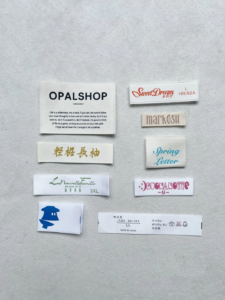
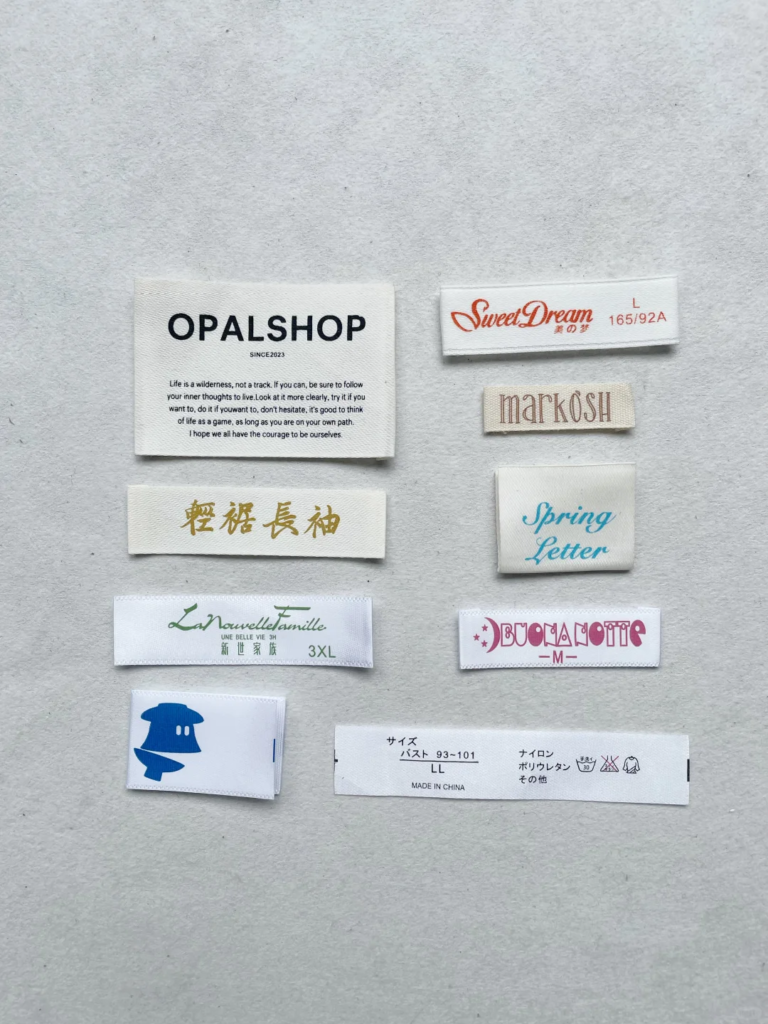
As the “identity certificate” of textiles, wash labels undertake the core function of marking brand information, fiber composition, washing methods and safety levels. The choice of material directly affects durability, texture and application scenarios. Nylon (polyamide) and polyester (polyester fiber) are the two most commonly used synthetic fiber materials in the field of wash labels. There are significant differences between them in performance, craftsmanship and application scenarios, which need to be carefully selected based on product positioning, usage environment and cost budget.
I. Core Differences: Material Properties Determine Performance Gaps
(I) Differences in Physical and Chemical Properties
Nylon wash labels are based on polyamide fibers, featuring a soft and delicate texture that is skin-friendly and non-irritating. They also possess excellent toughness and elasticity, capable of quickly rebounding after folding without permanent wrinkles. With outstanding ink absorption, the text and patterns printed or woven on them have bright and full colors with high detail reproduction. However, their light resistance is slightly poor—long-term exposure to strong light may cause slight fading, and they are prone to static electricity. In addition, nylon has strong chemical corrosion resistance and can adapt to most laundry aids, but its high-temperature stability is average; excessive ironing temperature may lead to deformation or discoloration.
Polyester wash labels are made of polyester fibers, boasting high strength, good stiffness, and better wear and scratch resistance than nylon, able to withstand repeated friction without damage. They excel in light resistance and high-temperature resistance, remaining unfaded and undeformed after long-term sun exposure or high-temperature washing, with strong dimensional stability. They are also not prone to static electricity and have excellent chemical stability, capable of resisting corrosion from bleaches, detergents and other chemical substances. However, polyester has a slightly harder hand feel than nylon; products without softening treatment may have a slight itchy sensation. Its ink absorption is relatively weak, requiring special inks to improve adhesion during printing.
(II) Differences in Process Compatibility
Nylon wash labels have broader adaptability to printing processes, compatible with flexographic printing, letterpress printing, screen printing and other methods. They can easily present complex patterns and gradient colors, and are particularly suitable for high-end processes such as jacquard and gold stamping, enhancing product texture through exquisite textures. Their edges are smooth after trimming or overlocking, with no risk of loose threads, making them suitable for scenarios requiring high detail and texture.
Due to the melting point characteristics of polyester, polyester wash labels are more suitable for trimming processes. High-temperature trimming achieves edge melting and sealing to prevent loose threads, ensuring high production efficiency and controllable costs. With mature weaving technology, they can be made into various textures such as plain weave and satin weave, suitable for large-scale standardized production. However, their reproduction accuracy of complex patterns in weaving is slightly inferior to that of nylon. In addition, polyester has strong compatibility with gold stamping and digital printing processes, rarely experiencing pattern peeling or fading.
(III) Differences in Cost and Cost-Effectiveness
The raw material and processing costs of nylon wash labels are higher than those of polyester. Especially when high-end nylon substrates are combined with complex processes, the cost advantage is not obvious, making them more suitable for mid-to-high-end product positioning. Polyester wash labels have sufficient raw material supply, simple production processes and low mass production costs. They are currently the most widely used wash label material in the market, with significant cost-effectiveness advantages, able to meet the large-scale production needs of fast fashion and affordable clothing.
II. Scenario-Based Applications: Precisely Matching Product Needs
(I) Application Scenarios of Nylon Wash Labels
With the characteristics of softness, skin-friendliness and superior texture, nylon wash labels are mainly suitable for products requiring high touch and high-end sense. In the clothing field, they are often used in high-end underwear, swimwear, lightweight knitwear, cashmere products and other close-fitting garments. Their soft texture can avoid discomfort caused by friction against the skin, while the bright printing effect highlights the detailed texture of the brand. In the outdoor products field, they can be used for jackets, mountaineering bags, etc., relying on their toughness and corrosion resistance to cope with complex usage environments. In addition, they are also applicable to light luxury women’s clothing, silk products, high-end home textiles, etc., strengthening the high-end brand tone through jacquard, gold stamping and other processes.
It should be noted that when nylon wash labels are used in outdoor or long-term sun exposure scenarios, it is recommended to adopt anti-UV treatment to improve light resistance and avoid fading.
(II) Application Scenarios of Polyester Wash Labels
With the advantages of wash resistance, wear resistance and controllable cost, polyester wash labels cover most daily textile scenarios. In the clothing field, they are widely used in daily wear such as T-shirts, jeans, sportswear and children’s clothing, able to maintain clear information after frequent washing and friction while meeting large-scale production needs. In the home textile field, they are suitable for linens requiring industrial washing such as bed sheets, quilt covers and towels; their high-temperature resistance and chemical resistance can cope with repeated industrial cleaning. In cross-border e-commerce products, polyester wash labels are stable in material, resistant to transportation and high in standardization, able to adapt to various logistics scenarios such as sea and air transportation, and their English standard labels can meet the compliance requirements of European and American markets.
For close-fitting polyester wash labels, softening and edge grinding treatment is recommended to improve skin-friendliness and avoid itching.
III. Selection Suggestions: Balancing Needs and Compliance
When selecting nylon or polyester wash labels, decisions should be based on three core dimensions: first, product contact attributes—nylon (or softened polyester) is preferred for close-fitting products, while polyester’s cost-effectiveness is more prominent for non-close-fitting products; second, usage environment—polyester is preferred for scenarios involving frequent washing, long-term sun exposure or industrial washing, while nylon is suitable for high-end texture needs and light-use scenarios; third, brand positioning and cost—high-end brands and designer styles can use nylon with complex processes, while fast fashion and affordable products mainly adopt polyester to balance cost and quality.
At the same time, regardless of the material selected, it must comply with the compliance standards of the corresponding market, such as China’s GB 18401 Safety Technical Code for Textile Products, EU REACH Regulation, and US FTC Labeling Act. It is necessary to ensure the accuracy of fiber composition, safety level and other information, and the material should be free of harmful substances such as formaldehyde and heavy metals. Obtaining ecological certifications such as OEKO-TEX® Standard 100 can improve market acceptance.
IV. Summary
There is no absolute superiority or inferiority between nylon wash labels and polyester wash labels; the core lies in scenario adaptation. Nylon excels with “soft texture + high-end process compatibility,” targeting mid-to-high-end close-fitting and light luxury categories. Polyester gains a foothold with “durability + high cost-effectiveness,” covering daily use, mass production and complex washing scenarios. In practical applications, flexible selection should be made based on product characteristics, brand positioning and cost budget. When necessary, process optimization (such as anti-UV treatment for nylon and softening treatment for polyester) can make up for material shortcomings, achieving both functionality and texture.